
Simple Self-Care Steps Every Mom Can Take to Boost Mental Health

Mothers and caregivers raising teens or managing a busy household often carry a mental load that never really clocks out. Between parenting stress factors like teen anxiety, school pressures, relationship shifts, and substance use concerns, it can feel like everyone else’s needs come first.

The result is familiar mothers’ mental health challenges: constant worry, shorter patience, and a quiet sense of disconnection from emotional well-being in motherhood. Maternal mental health support starts when the importance of self-care for moms is treated as a lifeline.

What Self-Care Really Means for Moms

Self-care for moms is not a luxury routine or a perfect morning. It is the choice to treat yourself as someone who matters, because self-care is not selfish. In real life, it looks like small, repeatable habits that support your body and emotions.

Those tiny practices add up. Over time, deliberate, proactive, and consistent activities can build emotional resilience so that hard moments feel more manageable. That often shows up as a steadier mood, more patience, and less snapping when stress runs high.

Think of it like charging a phone in short bursts. A two-minute breathing break before pickup, water before coffee, or a quick “no” to one extra commitment keeps your battery from hitting zero.

With this mindset, start-today steps like sleep tweaks, quick calming tools, and simple boundaries fit more naturally.

Small Self-Care Habits That Actually Stick

Try these simple practices to support your week.

Habits work because they take decision fatigue out of self-care. When you repeat a few small actions, you build steadier mood support that fits family life and strengthens your confidence over time.

Two-Minute Breath Reset

  • What it is: Do deep breathing exercises for ten slow breaths when tension spikes.
  • How often: Daily, plus anytime you feel overwhelmed.
  • Why it helps: It can lower stress and help you respond more calmly.

Consistent Sleep Bookends

  • What it is: Choose a fixed wake time and a simple 15-minute wind-down.
  • How often: Daily.
  • Why it helps: Predictable sleep cues support mood, patience, and clearer thinking.

Five-Minute Movement Snack

  • What it is: Walk, stretch, or do stairs until you feel warmer and looser.
  • How often: Daily.
  • Why it helps: Gentle movement releases tension and improves energy without needing a workout.

The One-No Boundary

  • What it is: Say no to one nonessential request and offer one alternative.
  • How often: Weekly.
  • Why it helps: Boundaries protect time and reduce resentment.

Screen-Off Tea Cue

  • What it is: Make caffeine-free tea and try relaxation techniques instead of scrolling.
  • How often: Most evenings.
  • Why it helps: A calming cue helps your nervous system downshift before sleep.

Pick one habit to start today, then shape it to your family’s rhythm.

 

hydrate & protein snack

Self-Care Q&A for Overwhelmed Moms

When real life gets messy, quick answers help.

Q: What are the simplest self-care habits that busy moms often overlook but can greatly improve mental health?
A: Start with basics that reduce stress fast: hydration, a protein-forward snack, daylight on your face, and a 2-minute breathing pause. Pair one habit with an existing routine, like brushing teeth or school pickup, so it happens automatically. Since prioritizing mental health matters in today’s society, tiny repeats can add up.

Q: How can moms balance their own mental health needs while managing the stress and anxiety of teenagers?
A: Hold space for their feelings without making them your nervous system’s job. Set a calm check-in window, reflect what you hear, and model coping out loud: “I’m anxious too, so I’m taking three slow breaths.” If worry is constant, consider looping in a counselor so you are not carrying it alone.

Q: What strategies can help moms say no to additional responsibilities without guilt?
A: Use a one-line boundary that honors your limits: “I can’t take that on right now.” Offer a small alternative you can truly do, like sharing a contact or swapping weeks. Remind yourself that protecting your bandwidth protects your patience at home.

Q: How do natural remedies and relaxation techniques support mental well-being for moms?
A: Gentle options like magnesium glycinate, caffeine cutoffs, brief stretching, and guided relaxation can help your body shift out of fight-or-flight. Track what helps for seven days, then keep the top two. If symptoms feel intense or persistent, it is a good time to seek professional support.

Q: If I’m feeling overwhelmed and stressed, how can I find safe ways to use terpene-rich products to relax and support my mental health?
A: First, confirm your foundations: sleep, food, movement, and stress skills, because no product replaces those. If you still want to explore options, choose reputable sources with clear lab testing, start low, and avoid mixing with alcohol or sedating meds. If you’re exploring a premium THCa cartridge, getting guidance from a clinician is a smart safety step. Since 1 in 8 people face mental health challenges, getting guidance from a clinician is a smart safety step.

You deserve support that fits your life, not another task to perfect.

Your 5-Minute Daily Self-Care Checklist

To keep it simple today:

This quick checklist turns good intentions into doable steps you can repeat even on chaotic days. Small actions protect your energy, and that matters when a mental health contributing factor shows up in maternal outcomes.

✔ Drink 12 to 16 ounces of water before coffee

✔ Eat a protein-forward snack within two hours of waking

✔ Step outside for five minutes of daylight and fresh air

✔ Do two minutes of slow breathing, longer exhale than inhale

✔ Move your body for ten minutes, walk or stretch counts

✔ Write one boundary sentence in a journal, you can use today

✔ Track one mood word each evening to notice patterns

Check off one item now, then let the next tiny win follow.
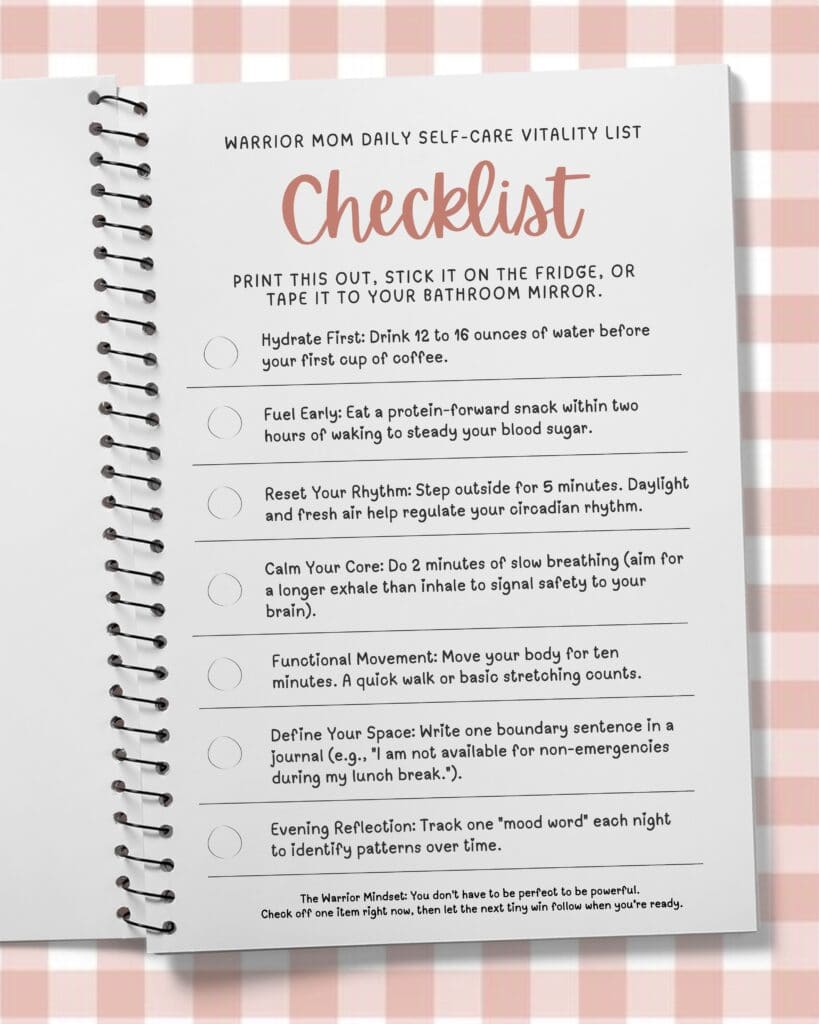
vitality self care check list

Download the above list here: Vitality Self-Care Check List!

As an Amazon Associate, I earn from qualifying purchases.

Protect One Small Self-Care Habit for Stronger Family Mental Health

Motherhood can feel like a nonstop loop of needs, leaving personal well-being pushed to the bottom of the list. The path forward is simple: choose small, consistent self-care and treat it as a basic part of caring for the whole family, not an extra.

Over time, that steady practice builds sustained mental health benefits, more patience, clearer thinking, and a calmer home, while reinforcing empowerment through self-care. Small self-care, done consistently, is how moms protect their mental health.

Pick one habit from the checklist this week, set one realistic boundary around it, and ask for backup if needed. Prioritizing personal well-being supports resilience and connection for everyone who depends on you.

See this list of 133 Self Care Things to Do For Yourself here!

Guide for Moms Helping Kids Build Lifelong Healthy Habits

For busy parents of young children, especially mothers and caregivers balancing work, teen anxiety in the household, or the extra layers that can come with adoption, child health and well being can feel like one more thing to manage perfectly. Healthy habits are not even on the radar for many.

The core tension is real: families want to guide children’s lifestyle choices with care, yet everyday parenting challenges like stress, picky eating, screen time battles, and inconsistent routines can make healthy family habits feel out of reach. Even so, kids don’t need flawless parents to learn what “normal” looks like at home. With small, steady shifts, families can shape routines that support lifelong well being.

Understanding How Healthy Habits Become “Normal”

Healthy habits are not willpower tricks. They are patterns kids absorb through child development, nutrition, and daily cues about what bodies and feelings need. When parents repeat small routines, children’s brains start to treat those choices as the default, not a constant debate.

This matters because family routines shape more than weight or energy. With 1 in 3 youth facing a mental, emotional, developmental, or behavioral problem, steady basics like food, movement, and sleep can support calmer moods and resilience. They also lower the pressure on you to “fix” everything at once.

Think of it like teaching a first language. If water is the usual drink and walks are the usual reset, kids reach for them without drama. Even positive parental influence links with healthier activity patterns, because children copy what gets repeated.

That’s why a simple “habit set” helps: food, movement, screens, calming skills, and sleep.

————————–

Daily and Weekly Habits Kids Actually Keep

Try these small routines for steady momentum.

These habits work because they make healthy choices feel predictable, not like another thing you must police. For moms balancing mental health and self-care, repeatable cues reduce decision fatigue and help you lead calmly over time.

Build-a-Plate Baseline
  • What it is: Serve a “three-part plate” with protein, produce, and a carb most meals.
  • How often: Daily
  • Why it helps: Predictable meals support steadier energy and fewer mood dips.
Ten-Minute Family Move
  • What it is: Do a short dance, walk, or stretch together before homework or dinner.
  • How often: Daily
  • Why it helps: Movement releases tension and improves focus for everyone.
Screen-Time Guardrails
Two-Minute Reset Breath
  • What it is: Practice box breathing together after school or before bed.
  • How often: Daily
  • Why it helps: It teaches kids a fast, portable calm-down skill.
Same-Three Bedtime Anchors
  • What it is: Repeat three steps: wash, read, lights out at the same time.
  • How often: Nightly
  • Why it helps: Consistency helps kids settle faster and wake more regulated.

Pick one habit this week, keep it simple, and adjust it to fit your real life.

————————

How to Add Wellness Routines Without Overhauling Life

Here’s how to move from ideas to healthy habits.

This process helps you introduce wellness routines in a way your kids can actually stick with, without turning your home into a constant negotiation. It matters for moms because a gradual plan protects your own mental energy while you model calm, consistent self-care.

1. Step 1: Choose one “tiny win” routine


Start with a single routine that takes 2 to 10 minutes and fits a time you already have (after school, before dinner, or at bedtime). Tell your child you are running a short experiment for one week, not changing everything forever. This keeps pressure low and boosts follow-through.

2. Step 2: Set a clear cue and a simple script


Pick one specific cue that triggers the habit (example: “When backpacks go down, we do our reset”). Use one calm sentence to explain the why: “This helps our bodies and brains feel steadier.” A predictable cue plus steady language prevents repeated debates and reduces your decision fatigue.

3. Step 3: Let your child help shape the options


Offer two choices that both meet your goal: “Do you want a walk or a dance break?” or “Do you want to read first or wash up first?” Choice creates cooperation because your child gets a voice, while you still hold the boundary.

4. Step 4: Reinforce effort, not results


Give quick, specific praise right after the routine: “You started right away, that was helpful,” or “Nice job taking three slow breaths.” Keep rewards simple and relational, like extra story time or picking the music, so the focus stays on connection and confidence.

5. Step 5: Track lightly, then adjust once a week


Use a 7-box checkbox on paper or a note on the fridge, and mark it once per day with your child. The habit of tracking daily and weekly behaviors can build consistency without making you micromanage, but avoid intensity if you tend to take tracking too far and feel stressed by it. At the end of the week, keep what worked, tweak one friction point, and repeat.

Small, steady repeats build the kind of calm confidence your family can lean on.

———————-

Real-Life Questions Moms Ask About Healthy Habits

When life feels messy, simple answers can bring relief.

Q: How can I encourage my child to develop healthy eating habits from a young age?


A: Aim for “mostly nourishing” rather than perfect meals, especially during stressful seasons. Offer regular meals and snacks, include one familiar food, and let your child decide how much to eat. Invite them to pick a fruit, stir, or set the table so food feels safe, not pressured.

Q: What are effective ways to motivate kids to stay active without feeling overwhelmed?


A: Keep movement short and playful: 5 to 15 minutes counts. Give two options you can live with, like a walk, a dance song, or a quick scavenger hunt. Tie it to stress relief by saying, “This helps our bodies settle.”

Q: How do I support my child in managing stress and anxiety as they grow?


A: Start by helping them name triggers such as school load, friendships, or schedule changes. Practice two quick tools together: box breathing for one minute and a 5-4-3-2-1 grounding scan. Knowing that many teens report persistent feelings of sadness can also reassure you that support is common and worthwhile.

Q: What strategies help balance screen time with outdoor activities for the whole family?


A: Choose clear “screen windows” and protect one daily outside anchor, even if it is ten minutes after dinner. Put phones to charge in a common spot and make the outdoors easy with shoes, balls, or chalk ready. Consistency beats long lectures.

Q: What steps can I take if I feel stuck balancing care giving responsibilities while considering ways to advance my own career options?


A: Start with a stress inventory: list what drains you most and what support you can ask for this week. Try a two-minute reset before planning, inhale for four, exhale for six, then write one small career step like updating a resume line, researching a structured online course, or exploring computer science studies. Tiny progress lowers pressure and restores direction.

You are allowed to build health and hope one small choice at a time.

——————–

Sustaining Healthy Habits Through Small Choices and Role Modeling

When family life is already stretched by stress, routines can feel like one more battle, and kids may push back just when structure matters most. The steady path is a mindset of long-term family wellness: focus on small, repeatable choices, lean on parental role modeling, and treat setbacks as information rather than failure.

Over time, this approach makes sustaining healthy habits feel normal, helping motivate children towards well being and encouraging lifelong healthy choices without constant negotiation. Consistency, not perfection, is what turns healthy habits into a family identity. Choose one next healthy choice today and name it out loud so everyone can see what “trying again” looks like. That’s how daily moments become resilience, stability, and connection for the years ahead.

Come back for more helpful content: My Warrior Mom Life

How to Help Teens with Anxiety Build Leadership Skills Step by Step

Parents and caregivers who want to help teens with anxiety often face a difficult balancing act: nurturing leadership skills while protecting fragile mental health. The tension is real, as anxiety and depression can shrink a teen’s confidence and make even small responsibilities feel overwhelming. Pushing for “more” can backfire, yet stepping in too much can leave a young person feeling incapable. This approach ensures you can help teens with anxiety by connecting leadership to wellness, making progress feel safe, steady, and possible.

Understanding Leadership When Anxiety Is in the Mix

Leadership in teens is not a personality type. It is a set of skills like initiative, empathy, and emotional regulation that grow through practice. Anxiety, low motivation, and mood shifts can change how those skills show up, but they do not cancel them.

This matters because you can stop treating leadership as “more pressure” and start treating it as “right-sized reps.” When mental health dips, drive often dips too, and 20.17% of U.S. teenagers report a major depressive episode, so pacing and support are part of the plan.

Think of a teen who can’t lead a group project today, but can text a teammate kindly or ask one clear question. That is empathy and initiative in a smaller form, and intrinsic motivation can build from there. With this lens, you can model wellness and set anxiety-aware goals that fit your teen’s current capacity.

Build Anxiety-Aware Leadership Skills at Home

This process helps you grow leadership skills without overwhelming an anxious teen by turning “leadership” into small, doable practices at home, school, and with friends. It also protects your energy as a parent because you’ll be coaching with clear steps instead of constant crisis-managing.

  1. Model steady wellness in plain sight
    Start by naming and practicing one simple regulation tool you want your teen to copy, such as a short walk, a glass of water, or a two-minute reset before talking. Keep it visible and calm so leadership looks like self-management, not perfection. 
  2. Choose one independence task with a clear finish line
    Pick a responsibility your teen can complete in 10 to 20 minutes, like emailing a teacher, packing for practice, or ordering their own meal. Make the target specific and observable, then step back while staying available for one question. Independence is a leadership foundation because it builds “I can handle this” evidence.
  3. Set one anxiety-aware goal and scale it to capacity
    Work together to choose a goal that stretches your teen slightly without flooding them, then define the smallest version that still counts. If social anxiety is high, the goal might be greeting one person or sending one friendly text, not leading the whole group. Agree on a backup plan for tough days, so the goal stays supportive instead of turning into pressure.
  4. Teach cooperation through one small coordinating role
    Invite your teen to practice leading with others in low-stakes ways, such as helping plan a hangout or managing a shared family task. A concrete option is to coordinate an activity with family or friends, with you acting as a quiet safety net if needed. Cooperation builds leadership because it strengthens communication, flexibility, and follow-through.
  5. Practice accountability and decision-making with a weekly review
    Once a week, ask three questions: What worked, what was hard, and what is the next right-sized step? Let your teen choose between two acceptable options so they get real decision practice without feeling trapped. Tie consequences to learning, not punishment, so setbacks become feedback.

Quick Answers for Stress-Smart Teen Leadership

Q: How can parents lead by example to help teens and young adults with anxiety and depression develop leadership skills centered on wellness?
A: Let your teen see you practice calm, repeatable self-care: a brief pause before reacting, a short walk, or asking for help early. Use simple language like “I’m noticing stress, so I’m resetting,” so leadership looks like regulation, not toughness. It also helps to normalize support since 30% of U.S. teenagers are already receiving mental health help.

Q: What strategies can encourage independence in teens and young adults who face anxiety and depression without increasing their stress?
A: Offer two manageable choices and let them pick, then keep the task small enough to finish the same day. Agree on a “pause plan” if anxiety spikes, such as taking five minutes and trying again once. Independence grows fastest when the experience ends in completion, not conflict.

Q: How can parents support goal-setting for their anxious or depressed teens while being mindful of their mental health challenges?
A: Co-create goals that include an easier backup version, so progress stays possible on hard days. Track effort and coping, not just outcomes, and celebrate follow-through on the smallest step. Treat the goal as information gathering, not a test of character.

Q: What are effective ways to teach cooperation and responsibility in teens and young adults managing anxiety and depression?
A: Give them a role that supports others without putting them on the spot, like organizing a shared calendar, setting up snacks, or confirming plans. Keep expectations concrete and time-limited, then debrief what felt stressful and what helped. Remember that over 80% of families identified informal caregivers as key supports, so looping in trusted adults can make teamwork feel safer.

Q: How can parents support their teens and young adults with anxiety and depression who are considering pursuing education or training in healthcare to advance their future opportunities?
A: Start by mapping your teen’s support network and mental health resources, including a clinician, school counselor, and one trusted adult mentor. Then explore flexible, low-pressure ways to test interest, like job shadowing, volunteering, or a short course, before committing to a full program. If direct patient care feels too intense right now, healthcare-adjacent paths like administration can still build leadership through planning, communication, and systems thinking, and those exploring healthcare management degree programs may find it useful to compare options.

Try These 10 Wellness-First Leadership Exercises This Week

When anxiety spikes, leadership practice needs to get smaller, not disappear. Pick a few of these wellness-first exercises to keep progress steady while protecting your teen’s energy, confidence, and support network.

  1. Two-Minute “Body Check + Plan” Huddle: Before any leadership activity (club meeting, group project, volunteer shift), do a quick check-in: “What’s my stress number 1–10? What would make this 1 point easier?” Then choose one tiny support (sit near a friend, ask for the agenda, take a water break). This builds self-awareness and teaches leadership as pacing, not pushing.
  2. Support-Network Map, Then Assign One “Helper Role”: Use the support map you started earlier and pick one person for one job this week: a teacher who can clarify expectations, a cousin who can practice a script, a coach who can offer a ride. The goal is sustained leadership progress through smart scaffolding, teens learn real leaders delegate and use resources.
  3. “Low-Stakes Lead” With a 10-Minute Micro-Role: Choose a role that’s helpful but not spotlight-heavy: timekeeper, note-taker, greeter, or question-collector. Set a clear start and finish: “Do this for 10 minutes, then you’re done.” This builds reliability and resilience because your teen gets a completion win even on harder mental-health days.
  4. Peer-Relationship Script Practice (3 Lines Only): Practice three short phrases that reduce social pressure: “Can you repeat that?”, “I need a minute, be right back,” and “I can do X, but not Y.” Run a 5-minute role-play at home, then your teen uses one line in real life. These scripts strengthen boundaries and collaboration, core wellness-centered leadership traits.
  5. Open Story Swap: “One Hard Thing, One Strength”: At dinner or in the car, you share a brief story of a challenge and what helped you through it; then invite your teen to share if they want. This mirrors open storytelling sessions that can build empathy and team trust, key peer relationship skills. Keep it optional and short; listening counts as participating.
  6. Create a “Plan B” for Flare Days (Without Quitting): Together, write two versions of the same commitment: Plan A (full) and Plan B (minimum). Example: Plan A is attending the whole meeting; Plan B is texting one idea to the group chat and reviewing notes afterward. This teaches consistency and reduces all-or-nothing thinking.
  7. Weekly Wellness Leadership Mini-Meeting (15 Minutes): Choose one day to review: What helped? What drained you? What’s one adjustment for next week? Use a simple structure inspired by communication as a core part of supportive systems, clear expectations lower anxiety and increase follow-through.

One Small, Wellness-First Step Toward Teen Leadership Confidence

When anxiety shows up, leadership can feel risky, your teen may want to grow, yet their nervous system says “not today.” A wellness-first mindset keeps expectations gentle and consistent, empowering parents to support leadership practice while honoring mental health needs and overcoming anxiety barriers without giving up hope for families. Over time, these supportive parenting strategies reduce shame, build steadier confidence, and keep motivating leadership growth even during wobbly weeks. Leadership can grow at the same pace as emotional safety. Choose one exercise tonight and practice it once this week, then notice what helped your teen feel most steady. This is how families build resilience, connection, and lasting wellbeing, one doable step at a time.

For Parents: Check out the list 133 Things You Can Do for Self-Care here.

The Hidden Hustle: Non-Ecommerce Small Business Ideas for Stay-at-Home Parents

There’s something revolutionary about stay-at-home parents building a thriving business in the gaps between school pickups, lunch prep, and nap times. It’s not just about income—it’s about autonomy, creativity, and making space for personal ambition within the chaos of home life.

Too often, the conversation around home-based work loops back to online shops and e-commerce, as if the only way to work from your kitchen table is to become a product-pusher. But there’s a deeper, richer world of small business ideas—offline services, skill-based hustles, community-oriented work—that sidestep the warehouse-in-your-garage model entirely.

For parents who want to blend entrepreneurship with presence, there’s no shortage of meaningful, profitable paths.

Home-Based Freelance Consulting: Let Your Past Life Fuel Your Future

You might have spent a decade building skills in marketing, education, HR, or finance before switching gears to raise a family. What you know is valuable, and it can become a consulting business that you run entirely from your home.

Offering services like resume building, grant writing, curriculum planning, or even small business HR consulting gives you the freedom to take on clients as your schedule allows. You don’t need a storefront, inventory, or a massive startup budget—you just need to package what you already know in a way that serves someone else’s needs. And for clients who prefer Zoom over in-person meetings, your living room becomes your conference room.

In-Home Childcare: Turn the Chaos Into a Community Service

If your days are already centered around childcare, it might make sense to fold a few more kids into the mix—especially if your area has long waitlists for daycare or preschools. Starting an in-home childcare service can be both fulfilling and sustainable.

You’ll need to navigate your state’s licensing requirements and possibly make a few home modifications, but you’ll be providing something your community desperately needs. The added bonus? Your own kids get built-in socialization, and you earn income without ever leaving the house.

Local Tutoring or Educational Coaching: Share What You Know

If you’ve got a knack for breaking down complex subjects or if you were once a teacher or academic, tutoring might be your sweet spot. Parents are always on the lookout for support with reading comprehension, math confidence, or standardized test prep, and most prefer someone local they can trust. You can conduct sessions in your home, meet at a local library, or offer virtual options for flexibility. This kind of business thrives on word-of-mouth and trust—two things that parent communities are very good at generating.

Meal Planning and Personal Chef Services: Cook With Purpose

Some people see a messy garage and cringe—others see a goldmine. If you’ve got a talent for creating order, decluttering spaces, or helping people create more functional home workflows, you could build a business organizing other people’s chaos.

Think closet makeovers, paper decluttering, kitchen resets, or digital file organization. You’ll be solving problems for other overwhelmed parents, and you don’t need to sell a single product to do it. Just a clear eye, a good strategy, and the patience to help others get unstuck.

Pet Services from Home: Dog Sitting, Walking, and More

You love animals, and your home is pet-friendly—why not open your doors to furry clients? Dog boarding, pet daycare, or even in-home grooming for neighborhood clients can be a cozy and low-cost business.

Licensing and liability insurance are necessary steps, but beyond that, this is a business built on relationships and reputation. Many pet owners are looking for someone more personal than a kennel or large chain, and a parent who’s home all day is uniquely positioned to meet that need.

Protect Yourself

Before your first invoice goes out or your website goes live, you’ll want to decide on a business structure—and that decision matters more than it seems. If you’re running a solo operation out of your home, forming an LLC with ZenBusiness can be a smart move, offering limited liability that protects your personal assets in case something goes sideways.

You also get potential tax perks, less bureaucratic weight than a full-blown corporation, and the flexibility to scale without jumping through hoops. You don’t need to shell out thousands to a lawyer, either; you can file on your own or use a trusted formation service. Just make sure to review your state’s specific rules—some require annual reports or publication notices, and those details can sneak up on you if you’re not watching.

This isn’t about hustling 24/7 or turning motherhood into another job. It’s about finding work that fits into your life—not the other way around. These business ideas don’t rely on product drops, inventory management, or scaling an online empire.

They rely on your brain, your hands, your heart, and the community around you. If you build something that energizes you, reflects your skills, and aligns with your family life, you’re not just running a business. You’re building your own version of freedom.

Discover the journey of resilience and transformation at My Warrior Mom Life, where real stories of overcoming technology-induced family crises inspire and empower.

Exciting Ways to Keep Learning Enjoyable for Your Child

In an era where education often feels like a chore, finding inventive ways to spark a lifelong passion for learning in your child is crucial. As a parent, you hold the power to transform learning from a mundane task into an exciting adventure. Here are some effective strategies to keep learning enjoyable and a thrilling journey for your little ones, courtesy of My Warrior Mom Life.

Explore the World Together

One of the most dynamic methods to nurture a love for learning is by stepping out of the conventional classroom environment. Take your child to museums where history comes alive, science centers where they can touch and interact with exhibits, or nature trails that offer lessons in biology and conservation firsthand. Attending cultural events can also broaden their understanding of the world, allowing them to experience diversity in thought and lifestyle firsthand. 

Set Goals as a Team

Collaboration in education strengthens the bond between you and your child and emphasizes the value of goals. Sit down together to discuss and set achievable learning objectives that are tailored to their interests and capabilities. This process not only motivates them but also teaches valuable skills in planning and responsibility. Whether it’s mastering a new math concept or completing a book, reaching these goals together can turn learning into a celebrated shared endeavor.

Model the Joy of Learning

When you dive into furthering your education, such as pursuing an online degree, you set a powerful example for your child. Engaging in studies like psychology allows you to delve into the intricacies of human behavior and cognitive processes, and this program can help you get started—check it out for more info. By balancing this pursuit with your other responsibilities, you showcase the lifelong value of education and personal growth, teaching your child that learning doesn’t have to stop at any age.

Engage with Hands-On Experiences

Swap passive screen time for active, hands-on learning to keep your child engaged. Activities that require interaction and manipulation, like science experiments, cooking, or art projects, make learning tangible and fun. These activities foster creativity and problem-solving skills, offering a more stimulating alternative to the passive reception of information through screens. 

Foster a Love for Reading

Dedicate time each day for reading to develop a lifelong reading habit. Choose a variety of books that align with your child’s interests to keep them intrigued and invested, and pick one to read together. Reading not only improves language skills but also opens doors to different worlds and ideas. This daily habit can become a cherished part of your child’s routine, setting the foundation for continuous learning and curiosity.

Cultivate Critical Thinking

Encourage your child to think critically by asking questions that stimulate reflective thought and imagination. Instead of questions with straightforward answers, pose scenarios that require them to consider different outcomes or solutions. This method enhances their analytical skills and encourages a deeper understanding of the content, helping them to apply knowledge in various situations.

Learn in Groups

Group learning can be a fun and effective educational approach. Organize small study groups with your child’s friends or involve family members in learning activities. This social interaction enhances learning, as children often enjoy sharing knowledge and skills in a group setting. It can also lead to innovative ideas and solutions, showing them the value of collaboration and diverse thinking.

Celebrate Learning Achievements

Acknowledging your child’s successes, no matter how small, significantly boosts their self-esteem and affirms their efforts. Whether it’s a breakthrough in a science project or a step forward in reading skills, seize every chance to celebrate. This recognition not only cultivates a positive outlook on education but also drives their ambition to continue exploring and learning. Each celebration acts as a stepping stone, reinforcing their desire to achieve and learn more.

Transforming learning into a fun and engaging experience requires creativity, commitment, and enthusiasm from both you and your child. By integrating these strategies into your educational approach, you not only enhance your child’s cognitive and emotional development but also instill a robust appreciation for the lifelong journey of learning. 

Finding a New Home: Navigating Change with Your Adopted Child

Relocating to a new home is a significant milestone for any family, particularly for those with an adopted child who may face unique challenges during this transition. Understanding and addressing these specific needs is crucial for ensuring a positive experience. This My Warrior Mom Life guide offers tailored advice to help adoptive families navigate the complexities of the home buying and selling process, fostering a smooth and nurturing move.

Building Trust Through Communication

Effective communication plays a crucial role in preparing adopted children for the transition of moving homes. Open, age-appropriate conversations about the reasons and expectations for the move are essential. It is important to recognize and affirm their feelings, addressing any concerns with empathy and reassurance. This not only lays a foundation of trust and security but also helps in fostering a sense of belonging and involvement in the family’s journey, ensuring the child feels heard and an integral part of the decision-making process. Additionally, this approach can significantly aid in easing any anxieties associated with the change, helping them to adapt more comfortably to their new environment.

Protect Your Investment with a Home Warranty

Investing in a home warranty for your new home is a smart move to safeguard against unexpected and costly repairs to your appliances or home systems. With a home warranty in place, you can have peace of mind knowing that essential repairs are covered, helping you avoid the financial strain of sudden breakdowns. To further enhance your protection, look for the electronics insurance option, which can cover the cost of repairing or replacing computers, televisions, certain smart home products, and more.

Leveraging Online Resources for Home Searching

Utilize online tools and resources to research potential homes and neighborhoods. Look for areas that are not only safe and child-friendly but also culturally diverse and inclusive. Online forums and community groups can provide valuable insights into the neighborhood’s culture and community spirit, aiding in making an informed choice.

Choosing an Energy-Efficient Home

Finding an energy-efficient home is a smart, sustainable choice that benefits both your wallet and the environment. These homes are designed with features like improved insulation, energy-saving appliances, and renewable energy sources to reduce energy consumption. Not only do they help lower monthly utility bills, but they also contribute to a healthier planet by reducing your carbon footprint.

The Advantage of Early Planning

Begin your moving preparations early, particularly for families with adopted children who might need extra time to adjust to the idea of relocating. A well-planned move reduces stress and provides a sense of control and predictability. This is especially beneficial for adopted children, who may have experienced instability in their early lives.

Moving Your Business

Relocating your business is a significant undertaking that requires careful planning and communication. It’s essential to keep your team informed throughout the process and establish a clear timeline, starting from the moment you decide to move. You can also reduce downtime by working remotely. 

Preparing for the New Environment for the Adopted Child

Acclimatize your child to the new home and surroundings before the move. Visit local landmarks, future schools, and community centers together. This helps build a sense of familiarity and anticipation, easing the transition and making the new environment less daunting.

Cost-Effective and Personalized Moving Strategies

Involve your child in the moving process, perhaps by letting them choose decorations for their new space. Opt for the help of friends and family during the move rather than hiring professionals. This approach not only saves costs but also provides a familiar and supportive environment during the transition. Furthermore, using recycled or donated packing materials can be a cost-effective and environmentally friendly option.

Moving with adopted children requires thoughtful consideration and sensitivity to their unique experiences and needs. By following these comprehensive strategies, adoptive families can ensure a nurturing and supportive transition into their new home. This journey, when navigated thoughtfully, can strengthen family bonds and provide a foundation for a happy and secure future in your new home.

Earn Money On the Side With These Business Ideas for Stay-At-Home Parents

earn money on the side

Image via Pexels

While most parents agree that raising a family is a full-time job on its own, few parents can comfortably afford to stay at home with their children without earning some kind of income. After all, there are bills to pay, food and clothing expenses for the whole family, and college tuition costs to save up for! Also there may be the added cost of treatment programs for your teens too!

Fortunately, earning money as a stay-at-home parent has never been easier. Remote work and freelancing are more popular than ever, and apps like TaskRabbit and DoorDash make it easy to join the gig economy as an independent contractor. Check out these tips from My Warrior Mom Life to discover a few flexible business ideas for stay-at-home moms and dads.

Try Freelance Writing, Bookkeeping, or Graphic Design

For stay-at-home parents with skills in areas such as writing, bookkeeping, or graphic design, freelancing could be a great way to earn an income and enjoy a flexible work schedule that allows them to continue caring for their children during the day.

Freelance writers create different types of written content for various publications and clients, while bookkeepers help companies track their income and expenses. Graphic designers use technology and art to create different types of visuals for the companies and clients they work with.

Freelancers can also work as:

  • Virtual assistants
  • Tutors
  • Proofreaders
  • Graphic designers
  • Bloggers
  • Software developers
  • Web designers
  • Social media managers
  • Childcare providers
  • Customer service representatives
  • Make money as an affiliate

There are a plethora of websites to find freelance work opportunities, including Designhill, Toptal, We Work Remotely, and Behance. However, it’s important to understand the differences between freelancing and working as an employee, as how you’re categorized will affect your taxes and how you’re paid for your work.

Keep in mind that if you’re freelancing as a web or graphic designer, you’ll need to find easy ways to share design ideas with clients. If you need to convert a file to make it less time-consuming to email, there are plenty of free online tools that you can use.

Become a Dropshipper

Dropshipping is another possible business idea for stay-at-home parents, especially those with an interest in pursuing entrepreneurship. This low-investment business idea is easy to start, as the costs associated with becoming a drop shipper typically include a domain name, online advertising, and product testing. But like any type of business, you’ll need to market yourself as a drop shipper in order to stand out online.

Launch a Photography Business

If you enjoy photography, you might also consider starting your own business as a freelance photographer. Some photographers specialize in staging and shooting weddings and events, while others shoot families, newborns, and maternity photos. Other types of photographers shoot products, fine art, landmarks, animals, food, and real estate.

Consider Ridesharing, Errand Running, and Food Delivery

Some other great ways to earn money as a stay-at-home parent include ridesharing, errand running, and food and grocery delivery. If you don’t mind driving, for instance, you could become a driver for rideshare companies such as Uber or Lyft. Or if you enjoy running errands, assembling furniture, doing yard work, and delivering food or groceries, you might consider becoming a Tasker for TaskRabbit. Other delivery apps to work for include DoorDash, Instacart, Shipt, and Uber Eats.

Learn How to Start Your Home-Based Business Today

Once you’ve chosen a business idea that fits your skills, interests, and busy schedule as a stay-at-home parent, your first step toward earning an income is writing a business plan. Your business plan should include a description of the company you’re starting, information about your financial needs and projections, and details about how your products or services will be sold. You’ll also need to decide how you’ll structure your new business.

After writing your business plan and choosing a business structure (also known as your legal entity), you can use an online formation service to easily set up a new company from home. Online formation services can be used to form a corporation or limited liability company (LLC), get a registered agent and a “doing business as” name, and apply for an employer identification number (EIN). Some businesses can be started as sole proprietorships — eliminating the need to use a formation service — but this type of legal entity isn’t right for everyone.

Learn How to Start Your Home-Based Business Today

Acquiring new customers is critical for any business’s sustainability. However, finding prospective clients can be challenging for many new businesses. This is where lead generation strategies come into play. Adopting solutions related to lead generation is vital for any organization that seeks to expand its customer base and generate revenue. Effective lead-generation strategies can increase a company’s visibility, establish its credibility, and ultimately stimulate growth. The importance of lead generation cannot be overstated. It is a fundamental process that lays the foundation for enduring business success.

Find the Job that Works Best for You

Making the decision to return to work isn’t an easy one when you’ve chosen to stay home with your children, but gig work, freelancing, and low-investment business ideas make it easier than ever to earn an income while continuing to care for your family. Online formation services make it as simple as possible to start a new business from home, and apps like Uber, Shipt, and Instacart allow you to join the gig economy at any time.

You may be returning to work, but there’s no need to find a standard 9-to-5 job when flexible and remote work opportunities are so readily available. You’ll earn some extra money without spending too much time away from your children, and you’ll keep your career alive at the same time.

Every family is different, but we can learn from each other. My family struggles with technology. Learn about our journey at My Warrior Mom Life!

How to Plan for the Next School Break


kid in school

Image via Pexels

How to Plan for the Next School Break

Children go to school 180 days a year, leaving you with little time to enjoy as a family during the school year. However, winter break usually lasts a little over a week, and spring break is only a few days, both of which are prime times for you and your family to spend quality time together. Today, My Warrior Mom Life has some tips to help make the next break more special.

Mini Vacation Destinations Ideas

While your children are home from school, plan a mini vacation. Visit a local inn or hotel with a pool. Consider having dinner delivered to your room as you and the entire family lounge in your pajamas, just relishing your time together.

Instead of an overnight trip, take day trips, and visit different local destinations during the break. For instance, visit a science center, play center, museum, library, or planetarium. Try to vary what you do, so all your children do something they enjoy. It also keeps your kids interested and entertained throughout the break.

Stay-at-Home Vacation Ideas 

If you have to work during the kids’ school break and can’t get away, a road trip is probably out of the question. However, with a little planning, a winter or spring break at home can be just as entertaining.

First, stay as comfortable as possible. It’s easier to run after the children if you wear something comfortable, like this lounge dress; click here to plan ahead and purchase a few new comfy clothing items. Your children may appreciate a new pair of pajamas, too, so they can remain comfortable, as well.

While you’re at home, consider scheduling a day to play board games or do arts and crafts. Designate one evening as a movie night where the family snuggles in the living or family room. When you’re deciding on a movie, it’s best to take a vote. Another idea is to have a spa day and pretend you and your family are lounging at a luxury resort.

Preparing for the Vacation 

Whether you’re planning to go away for the school break or stay home, start prepping for this time in advance. Finish all the laundry, run any errands, and clean the house before the school break. Don’t forget to go grocery shopping and select snacks everyone loves. Once you handle those tasks, you have nothing to focus on other than enjoying your time with the family.

Rules to Make the Most of This Time

Make it a time for little to no electronics. Savor every moment you can together without any distractions. Although your children may be a bit frustrated at first, once they’re having fun, they’re likely to forget all about their phones and tablets. Stick together most of the time to encourage interaction rather than having everyone disperse into their rooms. Also, avoid letting the kids stay up extremely late, so they wake up at a reasonable time and are in good spirits the next day.

Make the Next School Break a Time To Remember

With a game plan, you can make your children’s next school break a time for family and one they may remember forever. A little planning can make it more memorable (and less stressful) for you, as well.

My Warrior Mom Life is here to help parents like you navigate the modern world. Click here if you have any questions!

Navigating Common Mental Health Challenges as a Teen or Young Adult

There’s no denying that mental health can be tricky terrain to navigate, especially for teenagers and young adults who are still in the process of understanding and developing their sense of self. Anxiety and depression are two of the most commonly diagnosed mental illnesses, and they present unique challenges to young people. My Warrior Mom Life delves into some of these challenges and shares tips for fostering your mental health:

Stigma

One of the biggest challenges of anxiety and depression for young people is the stigma surrounding mental illness. Many people still believe that mental illness is something you can control or cure by sheer willpower — or that it’s a sign of weakness. As such, many young people neglect to get help because they don’t want to be perceived as weak, or they fear being judged or ostracized.

Lack of Understanding

Another major hurdle for young people is when their friends and family members fail to understand their anxiety or depression. Loved ones may not be able to grasp the severity of a young person’s illness, or they might dismiss symptoms as mere mood swings or teenage behavior. This makes it difficult for teens and young adults to get the support they need from those closest to them.

Navigating School and Work

Going to school and holding down a job can be difficult when you live with anxiety and depression. Difficulty, concentration, fatigue, and social avoidance are a few symptoms that make it hard to keep up with schoolwork, attend classes, and participate in extracurricular activities. If you struggle to concentrate on your tasks or interact with coworkers, this can also lead to poor job performance.

Consider the benefits of getting an online college degree. With the flexibility it offers, online learning lets you pursue your studies at your own pace and helps you balance work and personal commitments.

If you’re passionate about numbers, you might pursue an online accounting degree. This flexible learning option allows you to study from the comfort of your home and home so that you can balance your education with other commitments. An online accounting degree furthers your career, and immersing yourself in courses tailored to your interests will help you develop technical proficiency and a deeper understanding of the financial landscape.

Isolation

Anxiety and depression can be isolating illnesses, and many young people with these conditions feel alone or misunderstood. Some even descend into hopelessness or despair because they feel like they’re the only ones going through such experiences. Those who don’t have a support system often feel like they have nowhere to turn, exacerbating symptoms and making recovery even more difficult.

Accessing Professional Help

One of the biggest challenges for young people with anxiety and depression is getting professional help. If you’re like many other teens or young adults, you’re still dependent on your parents for financial support, and accessing treatment can be expensive. Plus, insurance may not cover the cost of your mental health treatment, and transportation to and from appointments can be hard if you don’t have access to a car.

Take time to research the online therapy options available to you. Telehealth continues to rise in popularity, and you may be able to get the services you need without leaving home.

Wrapping Up

Navigating mental health can be challenging for anyone, but young people with anxiety and depression face unique obstacles. From stigma and a lack of understanding to the challenges of school and work, isolation, and access to health, teens and young adults must tread complex terrain to get the support they need.

By increasing awareness surrounding these challenges, we can work to destigmatize mental illness and increase access to resources for those who need them. And if you are a young person living with mental illness, remember that communicating clearly with the people closest to you can go a long way toward regaining control and balance in your life. Don’t be afraid to reach out to get the help you need.

If you enjoyed this article, you can find more helpful content on MyWarriorMomLife.com!

Navigating Anxiety and Depression: Impactful Strategies

anxiety depression

As a young adult, you might feel like you’re constantly on a rollercoaster of emotions. The pressure to succeed, build relationships, and discover your purpose in life can be overwhelming.

If you’re experiencing feelings of anxiety or depression, you must understand that you’re not alone. The National Institute of Mental Health (NIMH) approximates that nearly 23% of adults 18 and older experienced a mental illness in 2021. The good news is that there are actionable steps to take to manage your symptoms and improve your mental health. My Warrior Mom Life shares some here:

Recognize Your Triggers

The first step in managing anxiety and depression is to identify your triggers. These can be specific situations, people, or even thoughts that cause you to feel anxious or down.

Learning to recognize your triggers will help you avoid them, or come up with healthy coping mechanisms to deal with them. For instance, if you feel anxious in crowded spaces, you might try going to a smaller gathering or bringing a trusted friend along for support.

Start Self-Care

Practicing self-care is critical for maintaining good mental health. Set aside time for yourself daily to do something you enjoy, such as listening to music, doing a puzzle, or reading a novel.

It’s also important to make your physical health a priority. Eating a healthy diet, getting adequate sleep, and exercising regularly will go a long way in boosting your overall well-being. When you take care of yourself, you’ll have more energy and mental clarity to deal with the challenges of everyday life.

Here is a list of over one hundred ideas for self-care from Warrior Mom! Click here!

Go Back to School

If you feel stuck in your career or struggle with anxiety and depression, returning to school can be a great way to improve your prospects and gain new skills. You can work at your own pace and fit studying into your busy schedule through online courses. Pursuing further education can also provide a sense of purpose and direction, which can prove invaluable in your mental health battles.

Further, earning a degree or certification, can open up new job opportunities and increase your earning potential. For example, there are countless ways to use a business bachelor’s degree, making it a wise long-term investment!

Talk to a Professional

It might be helpful to meet with a mental health professional if you’re experiencing persistent feelings of anxiety or depression. The right therapist or counselor can give you tools and strategies to manage your symptoms while offering support and guidance. Therapy can also help you identify any underlying issues that may be contributing to your mental health struggles.

Establish a Support System

Having a strong support system can make all the difference when fighting anxiety and depression. Reach out to trusted friends, family members, or support groups to connect with people who can empathize with your struggles. Sharing your experiences with others who have been there will likely help you feel less alone and more understood.

Focus on What You Can Control

Finally, it’s essential to focus on what you can control instead of what you cannot. Worrying about the future or dwelling on past mistakes is natural, but it only leads to more anxiety and depressive feelings.

Try to focus on the present moment and take small steps to improve your situation. For instance, if you’re worried about finding a job after graduation, put your energy into updating your resume or networking with people in your field.

Wrapping Up

Dealing with anxiety or depression is challenging, but it’s crucial to remember that you hold the power to take control of your mental health. Recognizing your triggers, practicing self-care, building a support system, and implementing the other strategies in this article can help you manage your symptoms and boost your overall quality of life.

Don’t forget that seeking help is a sign of strength, not weakness. There’s no shame in taking care of your mental health!

Please leave a comment below on how you personally handle anxiety or depression. Sharing is one way to show others that they are not alone.

If you enjoyed this article, you can find more helpful content on MyWarriorMomLife.com!